



£10.70
- Shop with Peace of Mind
- Efficient and effective customer service, online.
- Top-Notch Quality
- 100% High-Quality Guarantee

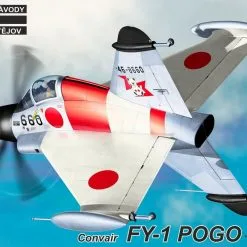
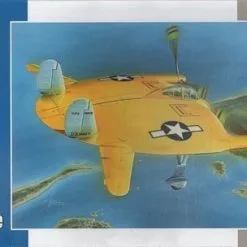
The Convair XFY Pogo was a tail-sitter that experimented with vertical takeoff and landing (VTOL).
A turboprop engine powered the Pogo, which had delta wings and three-bladed contra-rotating propellers.
It was supposed to be a high-capacity fighter that could operate from smaller warships.
The pilot had to look over his shoulder while gently operating the throttle to land the XFY-1, which was tough.
Following WWII, the Cold War encouraged the US Army and Navy to research VTOL operations.
By deploying VTOLs on any ship, task forces, convoys, or any fleet, even without aircraft carriers, might be protected.
These fighters would be placed in a conical protective housing, which would save precious deck space on ships.
Before more aircraft could be dispatched to assist, they would provide the first line of airborne defence and reconnaissance capability.
Lockheed and Convair were awarded contracts in May 1951 to design, build, and test two experimental VTOL aircraft that would be acceptable for employment by the military.
Despite contract provisions requiring each manufacturer to build two fighters, each was only able to build one, with Lockheed producing the XFV and Convair producing the XFY, dubbed the “Pogo.”
Only the second XFY-1 prototype, serial number 138649, was flown, with the first being utilised for engine testing and the third for static testing.
The Allison XT40-A-14 turboprop was built for the XFY-1, which was anticipated to deliver 7,100 horsepower (5,295 kW).
It was one of the rare propeller-driven aircraft with delta wings swept at 52 degrees and a fin span of 21 ft 8 in.
It was one of the few propeller-driven aircraft with delta wings swept at 52 degrees and a fin span of 21 ft 8 in (6.5 m).
The pilot’s seat was mounted on gimbals, which allowed it to move from 45 degrees vertical to 90 degrees horizontal in flight.
The three-bladed contra-rotating Curtiss-Wright turbo-electric propellers were 16 feet (4.88 m) in diameter.

| SKU | KPM72259 |
|---|---|
| Manufacturer | Kovozavody Prostejov |
| Scale | 1/72 |
| Short Description | Kovozavody Prostejov 1/72 Convair FY-1 Pogo 'In Service' (USMC, RN, JASDF) # 72259 |
Be the first to review “Kovozavody Prostejov 1/72 Convair FY-1 Pogo ‘In Service’ (USMC, RN, JASDF) # 72259”
Related products


Aircraft Kits
Aircraft Kits


Aircraft Kits
Reviews
There are no reviews yet.