

£97.99
- Shop with Peace of Mind
- Efficient and effective customer service, online.
- Top-Notch Quality
- 100% High-Quality Guarantee

The RMS Titanic was a British passenger liner owned by the White Star Line that sank in the North Atlantic Ocean on April 15, 1912, after colliding with an iceberg while on her maiden journey from Southampton to New York City.
More than 1,500 people died out of a total of 2,224 people on board, making it one of the deadliest single ship sinkings in history and the deadliest peacetime sinking of a superliner or cruise ship.
The accident has subsequently been the subject of many artistic works and a founding material of the disaster film genre, thanks to the widespread public attention it received in the aftermath.
The RMS Titanic was the second of three Olympic-class ocean liners operated by the White Star Line and was the largest ship afloat at the time she started service.
The Belfast-based Harland and Wolff shipyard constructed her.
The disaster claimed the life of Thomas Andrews, the shipyard’s senior naval architect at the time.
Captain Edward Smith, who perished with the ship, was in charge of the Titanic.
The ocean liner carried some of the world’s wealthiest people, as well as hundreds of emigrants from the United Kingdom and Ireland, Scandinavia, and other parts of Europe looking for a new life in America.
With a gymnasium, swimming pool, library, high-class restaurants, and lavish cabins, the first-class accommodations were designed to be the height of comfort and elegance.
The ship had a high-powered radiotelegraph transmitter for sending passenger “marconigrams” and for operational purposes.
Watertight compartments and remotely actuated watertight doors were among the Titanic’s innovative safety measures.
The ship was equipped with 16 lifeboat davits, each capable of lowering three lifeboats for a total of 48 boats.
Titanic, on the other hand, had just 20 lifeboats, four of which were collapsible and difficult to launch during the sinking.
Due to the marine safety requirements of the period, the carried lifeboats were enough for 1,178 people—roughly half the amount on board and one-third of her total capacity.
The lowered lifeboats were only about half-filled at the time of the catastrophe.
Titanic departed Southampton on April 10, 1912, and made stops at Cherbourg, France, and Queenstown, Ireland (now Cobh), before going west to New York.
At 11:40 p.m. ship’s time on 14 April, four days into the crossing and about 375 miles (600 km) south of Newfoundland, she collided with an iceberg.
The accident caused the hull plates to bend inwards along her starboard (right) side, allowing the sea to enter five of her sixteen watertight compartments; she could only withstand four floodings.
Passengers and crew members were evacuated on lifeboats, many of which were only partially loaded when launched.
Because to a “women and children first” procedure for filling lifeboats, a disproportionate number of men were left on board.
She split apart and sank around 2:20 a.m., with well over a thousand people still on board.
The Cunard liner RMS Carpathia arrived just under two hours after the Titanic sank, bringing an estimated 710 people aboard.

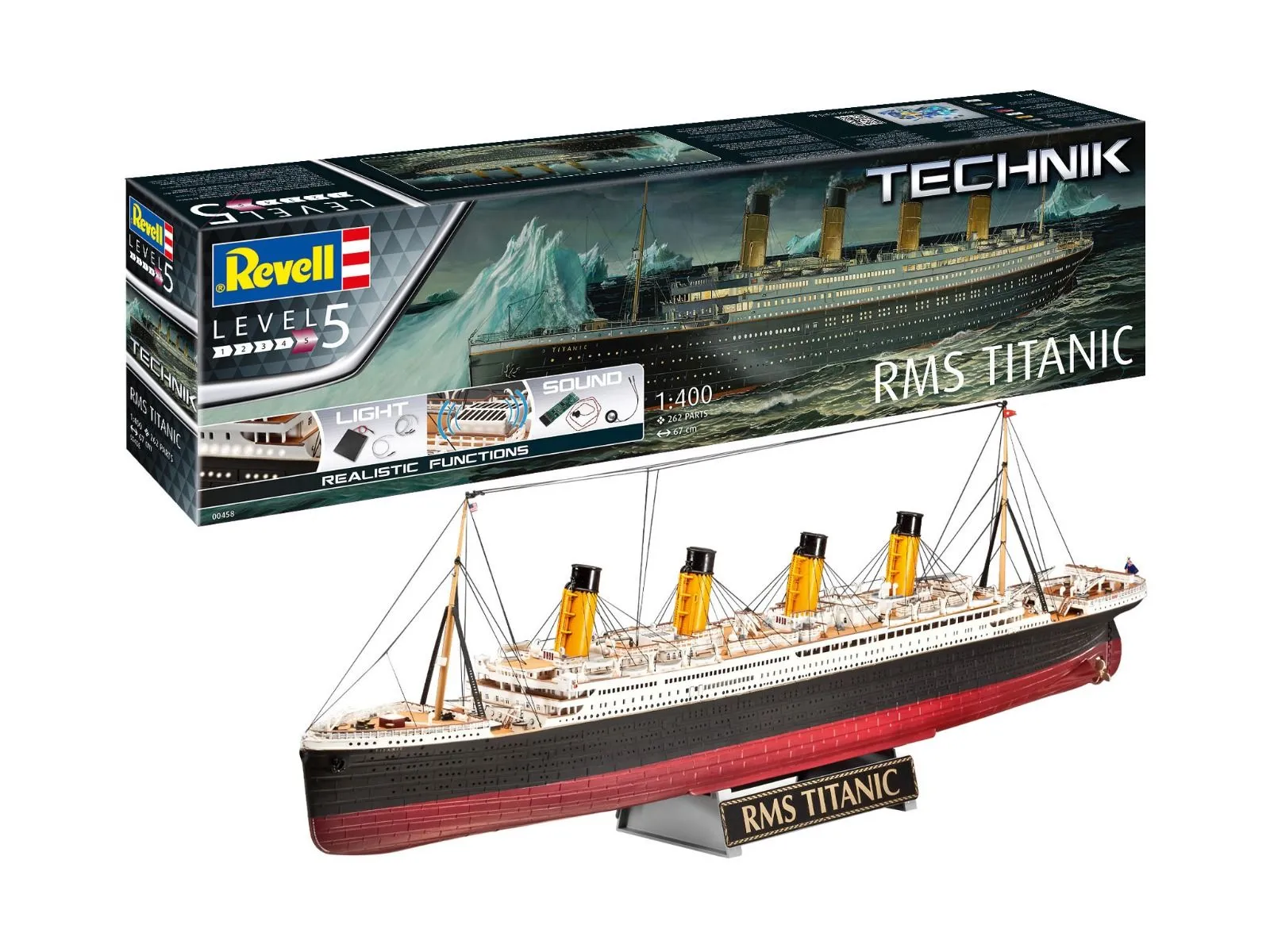
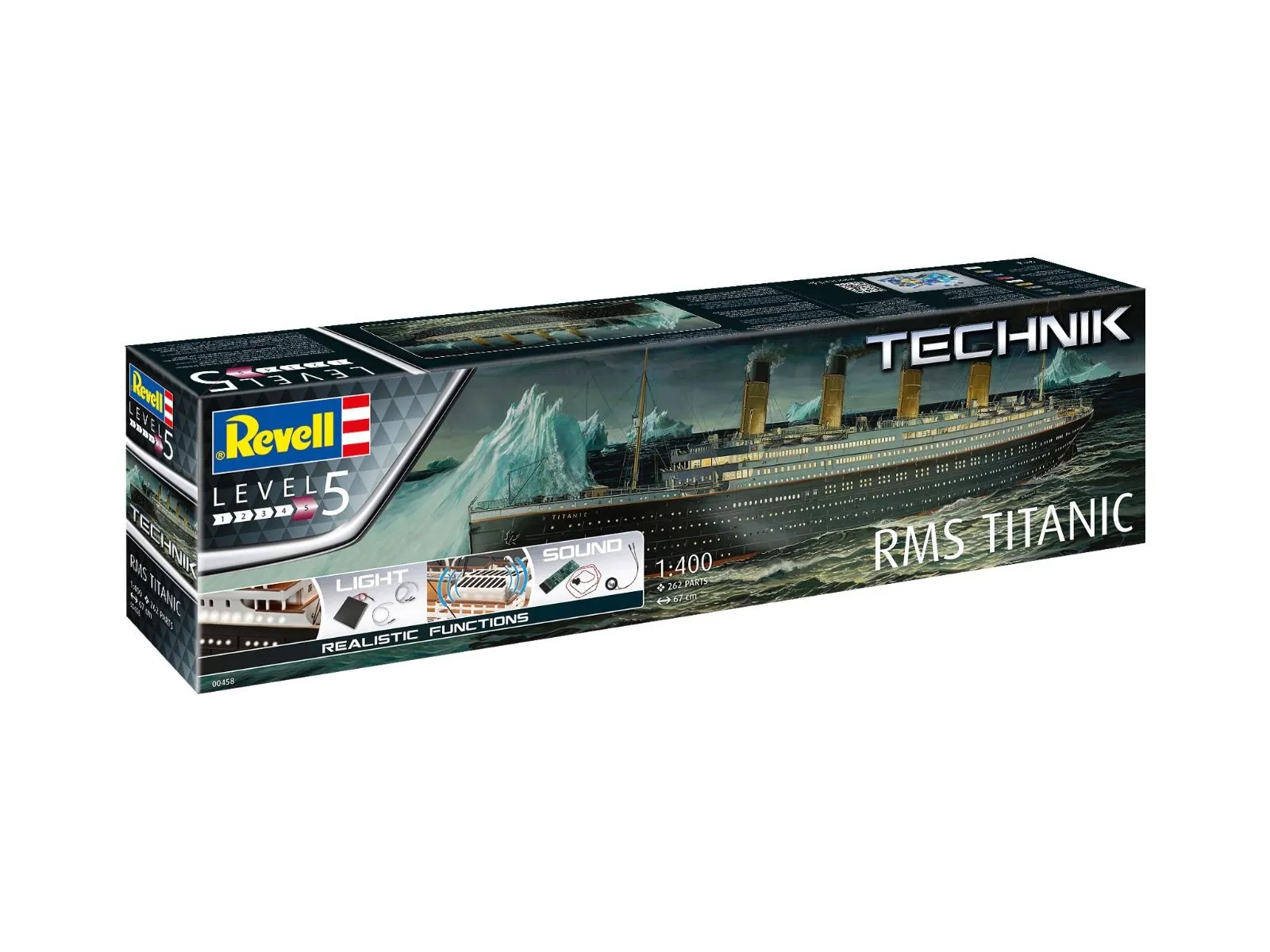
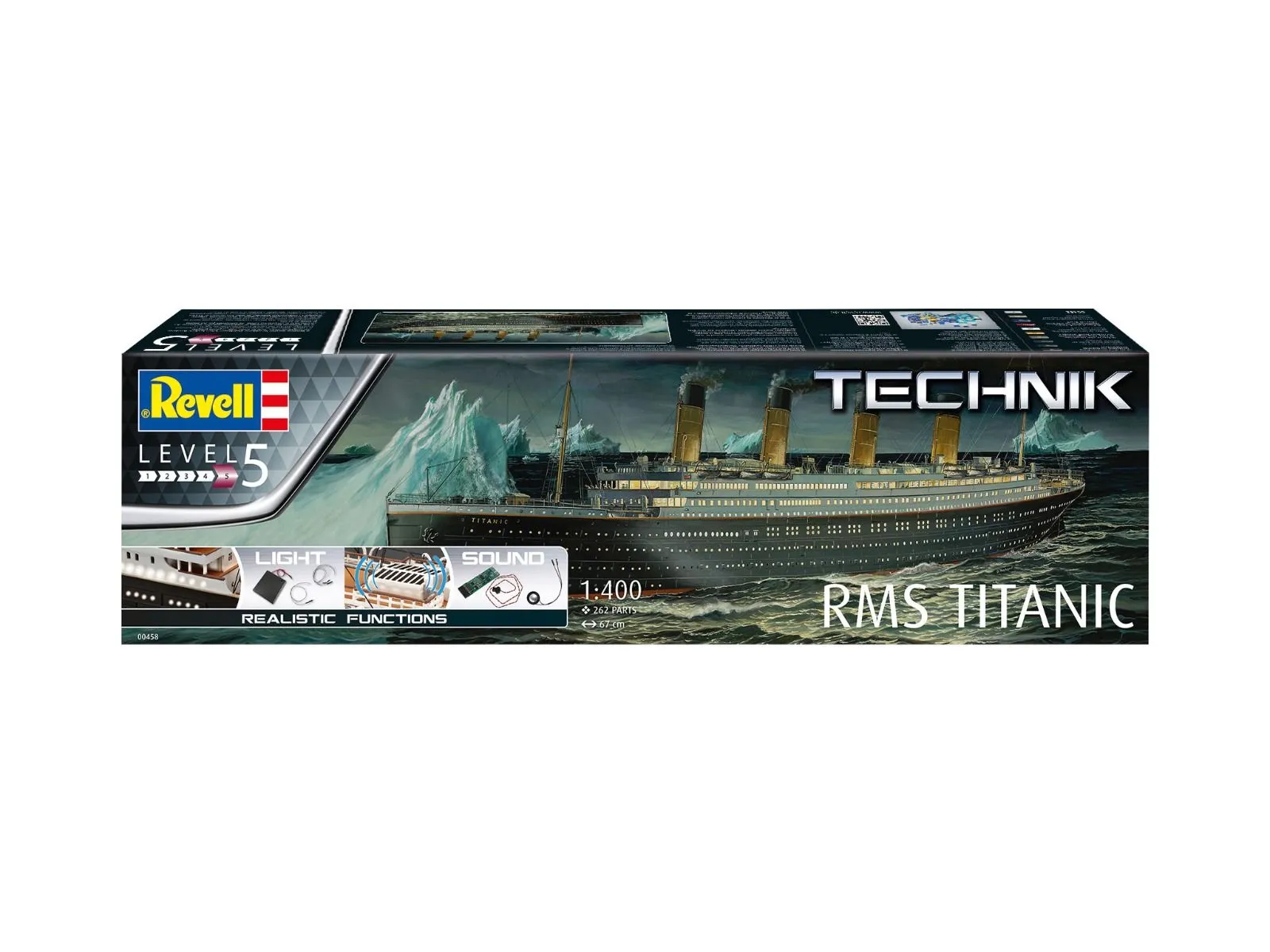
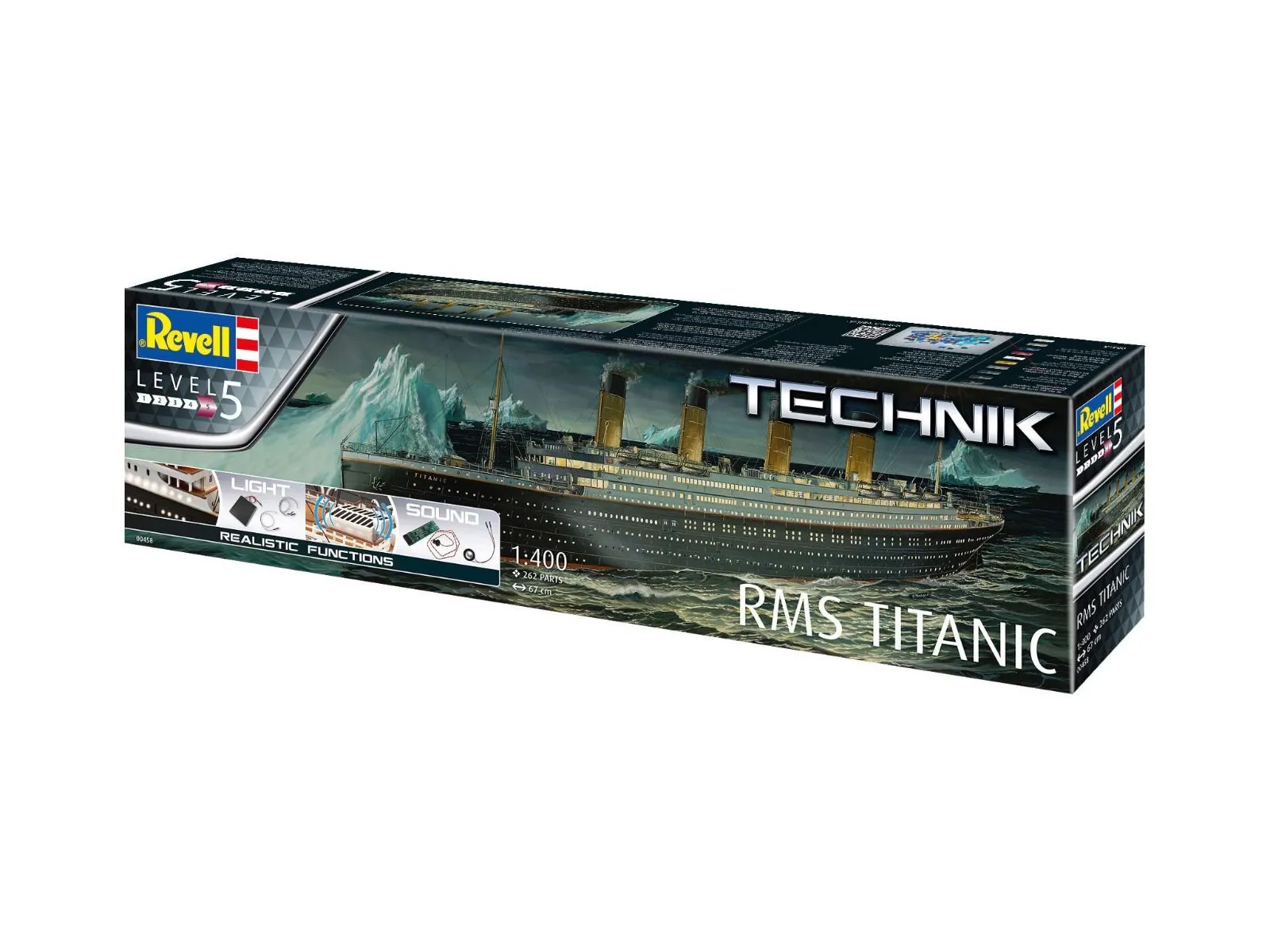
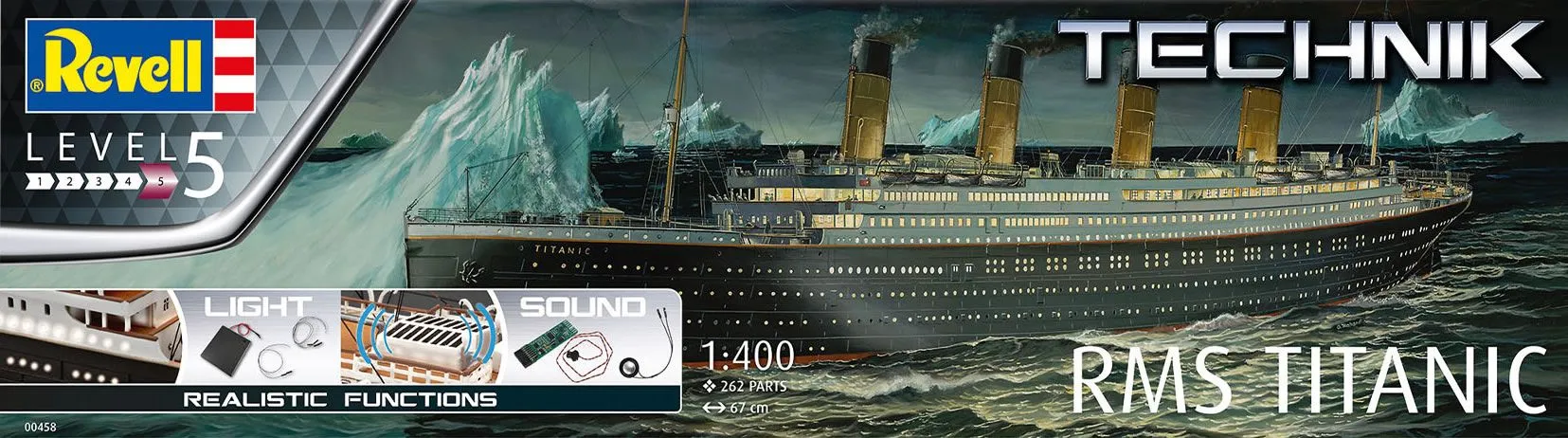
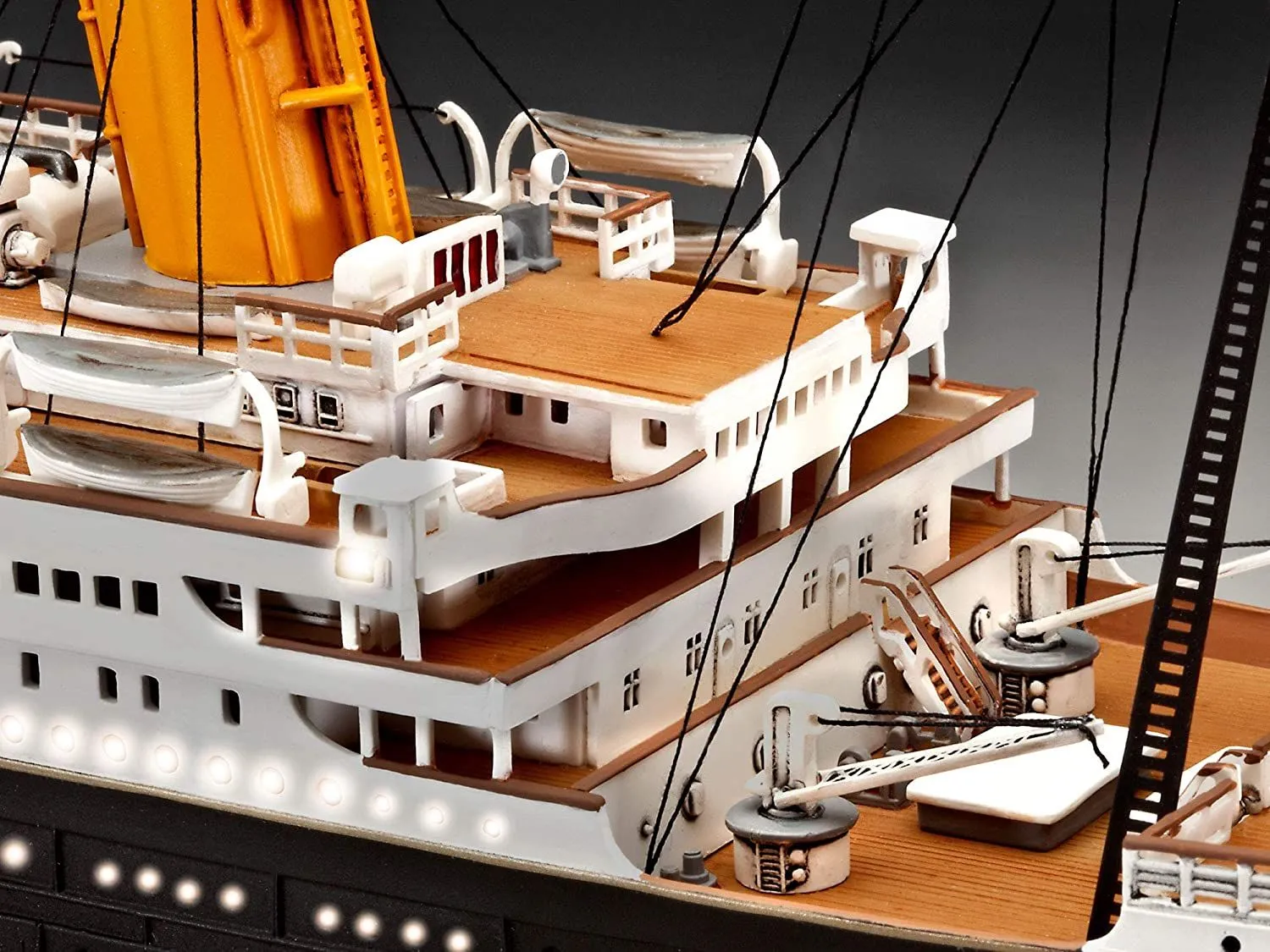
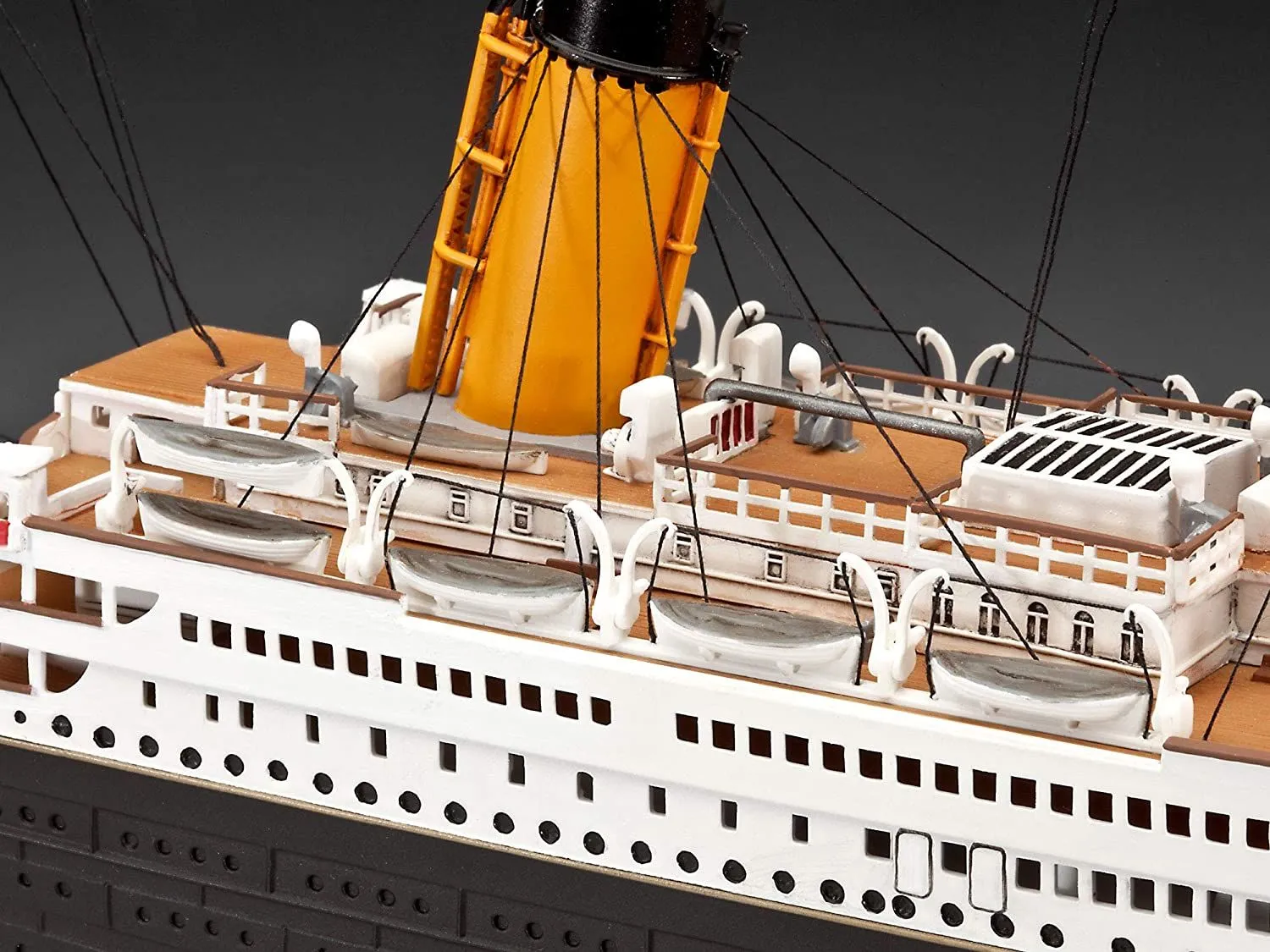
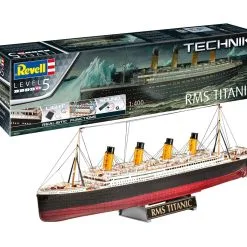
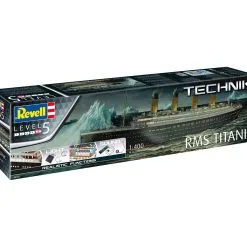
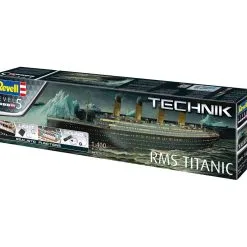
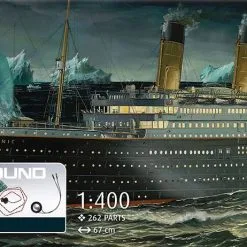
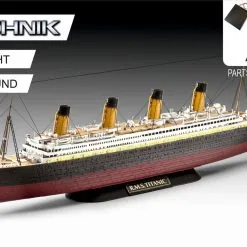
Multi-part, sophisticated kit of the legendary RMS Titanic, which sank in the icy waters of the North Atlantic on its maiden voyage.
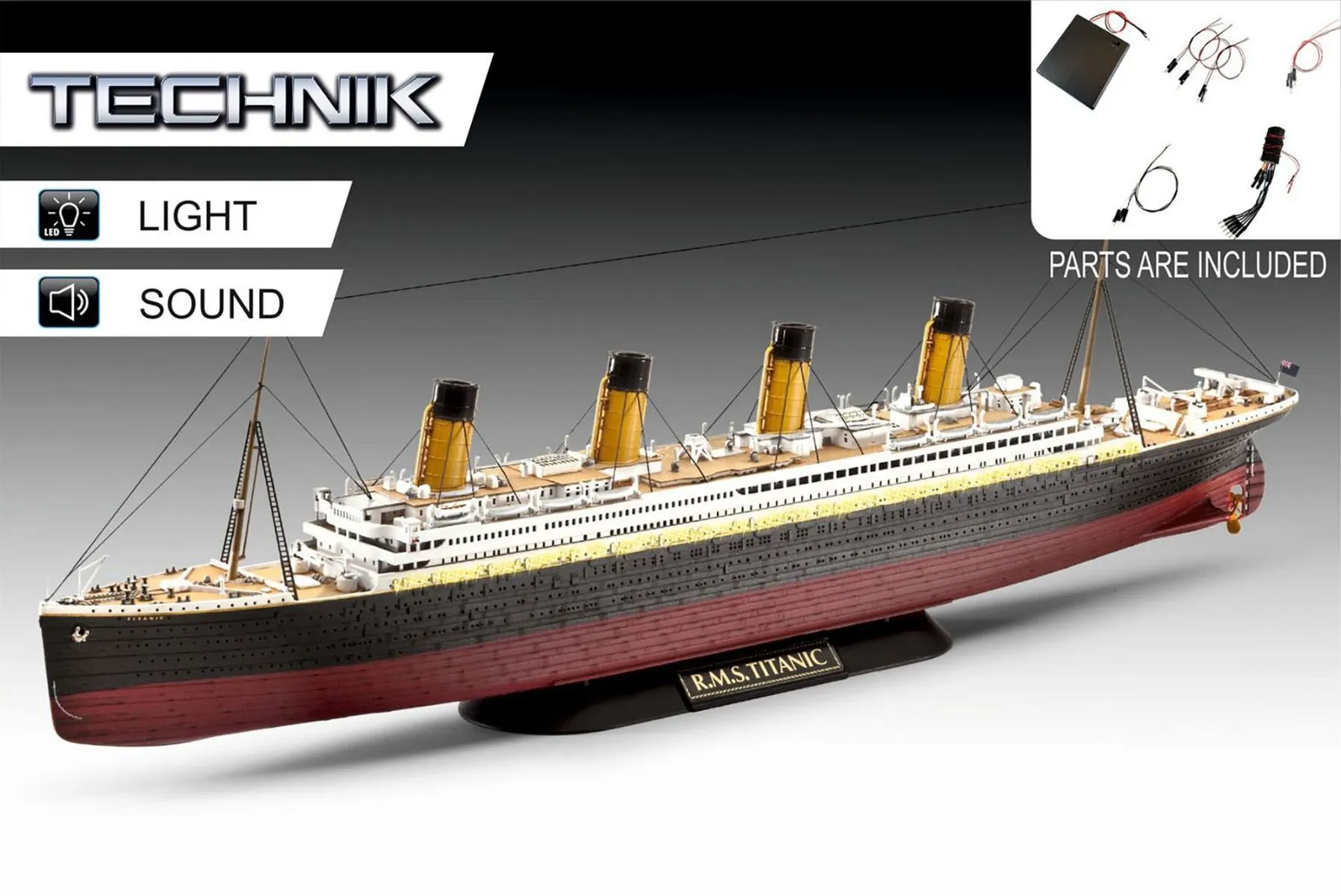
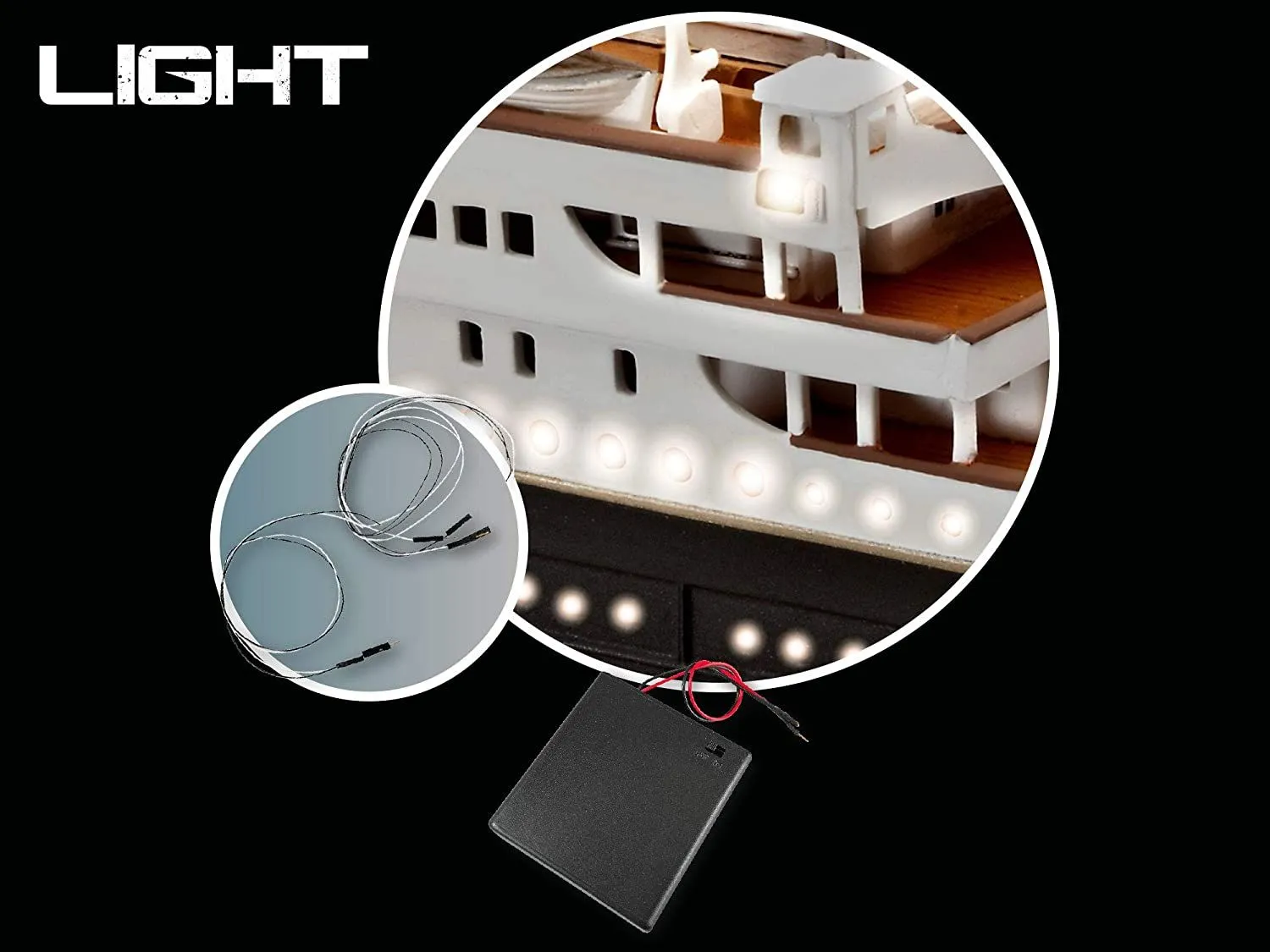
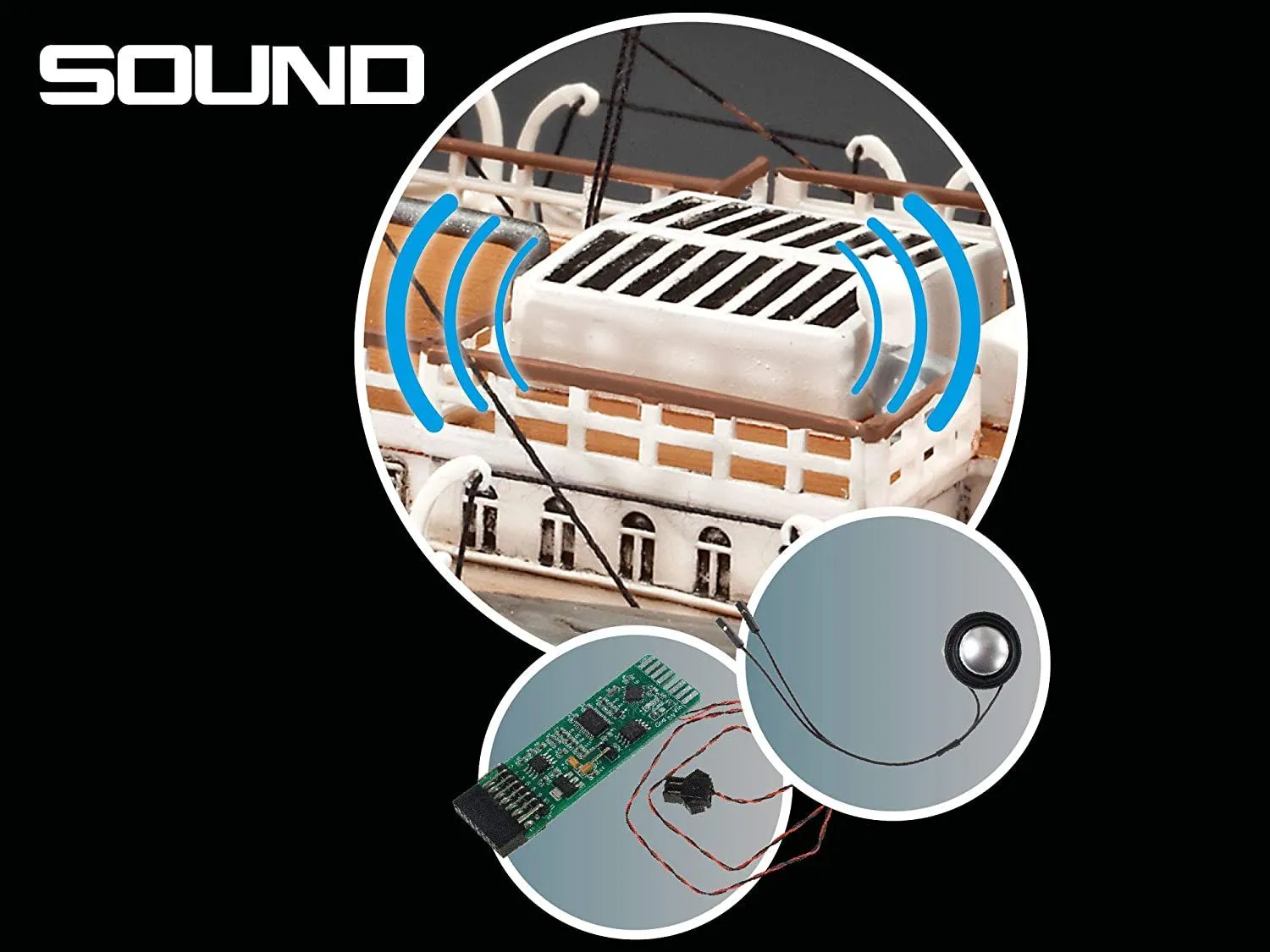
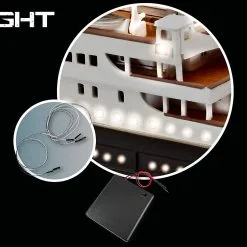
Electronic components individually matched to the kit and directly mountable with convenient plug-in connections.
– LED for illumination of hull, navigation and position lights
– Preprogrammed control unit for displaying realistic scenarios
– Sound module with authentic ship sounds
– Battery box (4x 1.5 V AA batteries, not included)
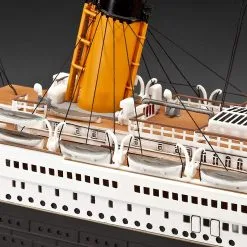
– Detailed hull with textured planking
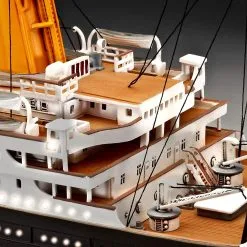
– Lifeboats and davits
– Stairways
– Detailed decals with decorative stripes
| SKU | RVL000458 |
|---|---|
| Manufacturer | Revell |
| Scale | 1/400 |
| EAN | 4009803004587 |
| Short Description | Revell 1/400 R.M.S Titanic Teckniks with Lights & Sounds # 00458 |
Be the first to review “Revell 1/400 R.M.S Titanic Teckniks With Lights & Sounds # 00458”
Related products
Aircraft Kits
Boat & Ship Kits
Boat & Ship Kits
Aircraft Kits
Aircraft Kits
Aircraft Kits
Aircraft Kits
Reviews
There are no reviews yet.