£9.79
- Shop with Peace of Mind
- Efficient and effective customer service, online.
- Top-Notch Quality
- 100% High-Quality Guarantee

The M4 Sherman tank was created in a variety of versions as a result of mass production that spanned several years and several manufacturers.
It was also the foundation for a number of similar vehicles, and Shermans have been modified by a variety of countries, ranging from minor enhancements to entire hull alterations for a different mission.
M4 variations were still in use by Israel during the 1967 and 1973 wars, despite being designed in 1941.
In July–August 1944, a Sherman ARV MK I recovery vehicle was photographed near Caen.
In the early 1940s, militaries all over the world were just beginning to investigate the many different tasks that a tank could be assigned.
As vehicles like the Sherman were frequently up against enemy armour, theories of what vehicles should be confronting enemy tanks altered, and some of the most critical first changes concentrated around up-gunning the basic vehicle.
It wasn’t long before the vehicle’s mobility, protection, and particular variations for infantry support tasks were all improved.
The British, who got a number of Shermans through Lend-Lease during the war, would make similar modifications to the main armament.
Many early Sherman models were modified to armoured personnel carriers (known as “Kangaroos”) or armoured recovery vehicles.
An amphibious “swimming” version of the Sherman was used in preparation for the Allied invasion of Europe in 1944. Up until the end of WWII, extensive effort was done on developing mine clearance systems that could be mounted to Shermans in some way.
Large numbers of surplus Shermans were shipped to various countries after WWII, particularly to South America and the Middle East.
Israel became the greatest postwar user of Sherman tanks, undergoing substantial modifications to retain them in front-line duty as tanks, mobile artillery pieces, armoured ambulances, and other vehicles until the early 1970s.
During the October War of 1973, several soldiers saw action. In South America, similar modifications and acquisitions of Israeli-modified Shermans were made, and they served as the final fighting Shermans until 1989.
| SKU | UNIM380 |
|---|---|
| Manufacturer | UniModel |
| Scale | 1/72 |
| EAN | 4589913349810 |
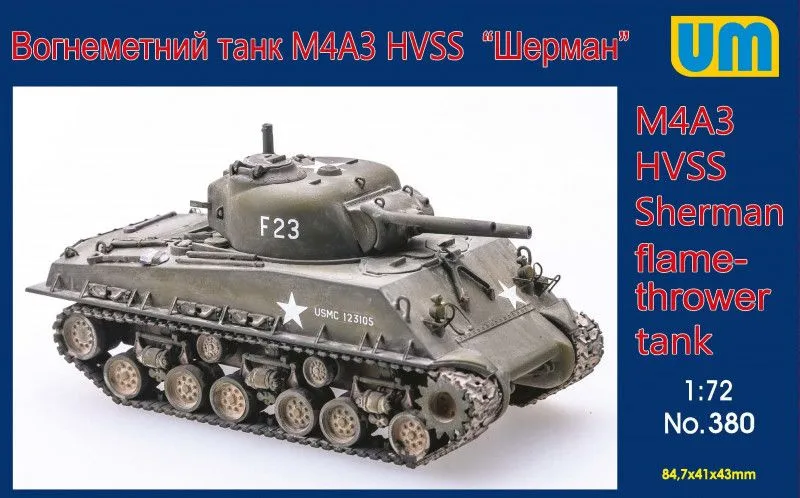
| Short Description | Unimodel 1/72 M4A3 HVSS Sherman Flame Thrower Tank # 380 |
Be the first to review “Unimodel 1/72 M4A3 HVSS Sherman Flame Thrower Tank # 380”
Related products
Military Kits


Military Kits
Military Kits
Military Kits
Military Kits

Military Kits
Military Kits
Reviews
There are no reviews yet.